The Lifespan and Legacy of Shem’s Descendant
By Ifeoma Egbogah in visualization, blog, tidytuesday
January 13, 2025
Genesis has always been one of my favorite books in the Bible! There’s something profoundly captivating about diving into its stories and wisdom. Over the years, I’ve enjoyed reading it from cover to cover, and I find the genealogical records particularly fascinating—even if I sometimes stumble over the names (a pronunciation guide would be a lifesaver!).
Genesis: A Journey Through the Genealogies
Recently, while revisiting the 11th chapter, my curiosity was sparked once again, and I couldn’t help but dive deeper. It led me to ask some intriguing questions.
I couldn’t resist the urge to explore further, so I gathered the data from the genealogical accounts and created a visualization to answer these questions. The results were both enlightening and humbling, reminding me of the depth and richness hidden in these ancient records.
chart
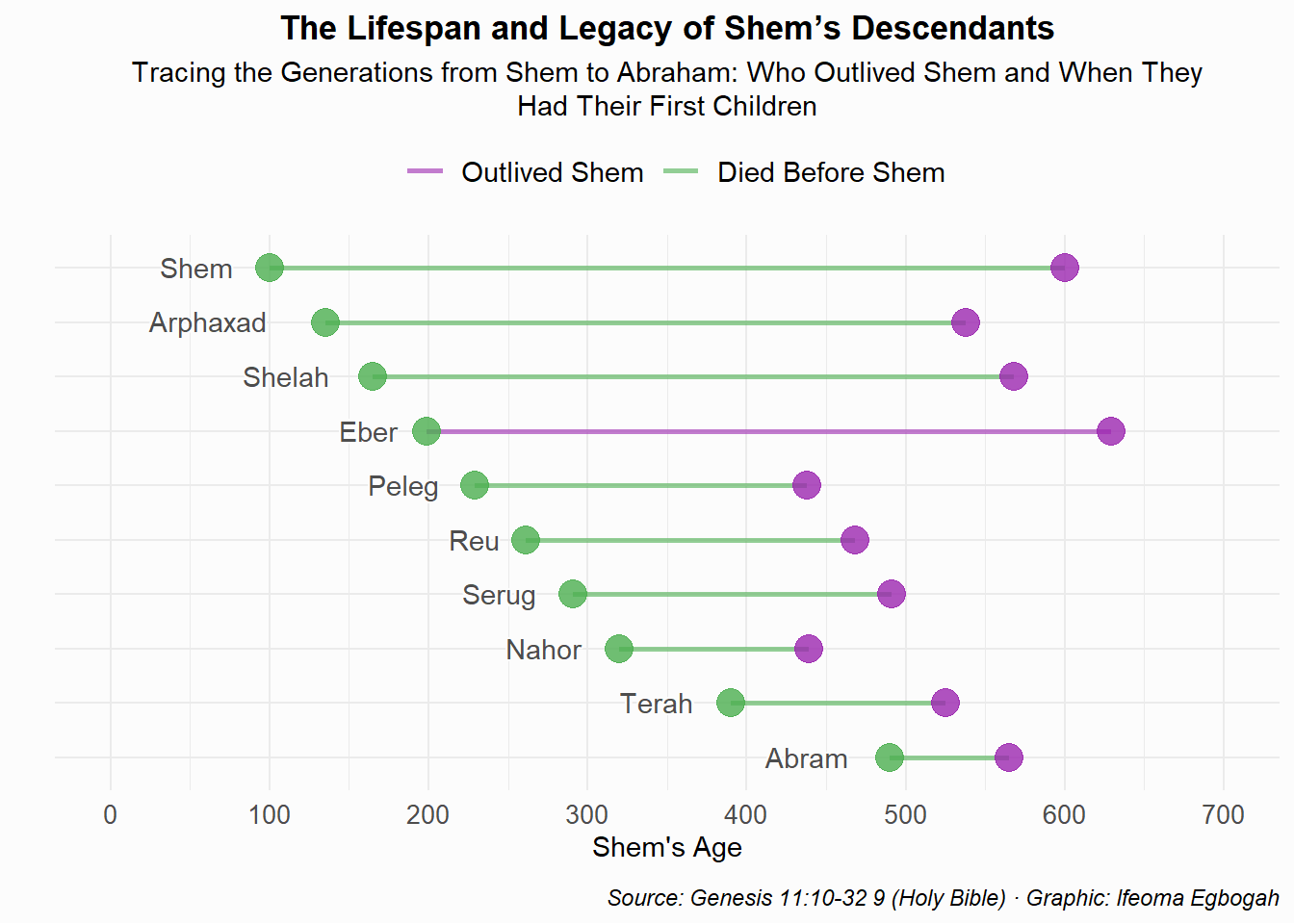
chart <- gen %>%
  mutate(shem_death = 600,
    shem_age_after_first_birth = cumsum(age_at_first_child),
         lived_after_first_birth = total_lifespan - age_at_first_child,
         shem_age = lived_after_first_birth + shem_age_after_first_birth,
         outlived_shem = ifelse(shem_age > shem_death, "Outlived Shem", "Died Before Shem"),
        name = factor(name, levels = rev(unique(name)))) %>%
  ggplot() +
   geom_segment(aes(x = shem_age_after_first_birth, xend = shem_age, y = name, yend = name, colour = outlived_shem), linewidth = 1, alpha = 0.6) +
  geom_point(aes(shem_age_after_first_birth, name), colour = "#4CAF50", alpha = 0.8, size = 5) +
  geom_point(aes(shem_age, name), colour = "#9C27B0", alpha = 0.8, size = 5) +

  shadowtext::geom_shadowtext(aes(x = shem_age_after_first_birth,y = name, label = name), hjust = 1.5, nudge_x = -0.015, colour = "grey30", bg.color = "grey99", vjust = 0.45) +
  scale_x_continuous(breaks = seq(0, 700, 100), limits = c(0, 700)) +
  scale_colour_manual(values = c("#4CAF50", "#9C27B0"), guide = guide_legend(reverse = TRUE)) +
  coord_cartesian(clip = "off") +

  labs(title = "The Lifespan and Legacy of Shem’s Descendants",
       x = "Shem's Age",
       y = "",
       subtitle = str_wrap("Tracing the Generations from Shem to Abraham: Who Outlived Shem and When They Had Their First Children"),
       caption = "Source: Genesis 11:10-32 9 (Holy Bible) · Graphic: Ifeoma Egbogah",
       colour = "") +
  theme_minimal() +
  theme( legend.position = "top",
    legend.text = element_text(size = 11),
     axis.text.y = element_blank(),
    plot.background = element_rect(fill = "grey99", color = NA),
    axis.text = element_text(size = 10),
    plot.title = element_text(face = "bold", hjust = 0.5),
    plot.subtitle = element_text(lineheight = 1, hjust = 0.5),
    plot.caption = element_text(margin = margin(10, 0, 0, 0), face = "italic"))
Exploring the Lifespans of Shem’s Descendants
This visualization explores the lifespan of each descendant, focusing on two key aspects: the age of Shem when each descendant had their first child and whether they outlived him.
Unpacking the Plot
The plot uses a dumbbell chart to represent the relationship between Shem’s age and the milestones of his descendants. Here’s how to interpret the key components of the chart:
-
Green Dots and Lines:
- The green dots indicate how old Shem was when each descendant became a parent for the first time.
- The green lines represent the lifespan of descendants who died before Shem, illustrating that they did not live to see the full span of his 600 years.
-
Purple Lines:
- The purple lines represent Eber, who is the only descendant from this lineage recorded to have outlived Shem, living 64 years beyond him.
Key Insights
-
The Remarkable Longevity of Shem:
- Living for 600 years, Shem outlived nearly all his direct descendants apart from Eber. This longevity provides a striking contrast to the decreasing lifespans of subsequent generations.
-
The Decline in Lifespan Across Generations:
- From Arphaxad to Nahor, there is a clear decline in lifespans. Nahor, for instance, lived for only 148 years, a stark contrast to Shem’s 600 years.
-
The Age of Fatherhood:
- The plot reveals that most of Shem’s descendants had their first child in their early 30s, except for Nahor and Terah, who were slightly older.
-
Transition to Abraham:
- The lineage culminates in Terah, who fathered Abram (later Abraham), Nahor, and Haran. This marks a critical juncture in biblical history, transitioning from a focus on longevity to the covenantal promises made to Abraham.
Theological Implications
The genealogical record underscores several key themes in biblical theology:
- God’s Sovereignty: The preservation of Shem’s lineage demonstrates God’s providence in sustaining the family line leading to Abraham.
- Human Mortality: The gradual decline in lifespan reflects the consequences of sin as described in earlier biblical narratives, such as Genesis 3.
- Covenantal Promise: This genealogy serves as a bridge between the aftermath of the flood and the covenant God makes with Abraham in Genesis 12.
Why This Matters Today
Understanding the lifespans of Shem and his descendants gives us a greater appreciation for the biblical narrative and its emphasis on faith, legacy, and the unfolding of God’s plan for humanity. For those interested in genealogy, this account also highlights the importance of preserving family history and celebrating the milestones of previous generations.
Creating the Visualization
This visualization was designed to make biblical data more accessible and engaging. It translates genealogical records into an easy-to-read chart, enabling readers to explore the relationships between Shem and his descendants in a new light.
Conclusion
The genealogical account of Shem to Abraham is more than a historical record; it’s a testimony to endurance, legacy, and divine purpose. As we reflect on these lifespans, may we find inspiration to leave a lasting impact on the generations that follow.
Your Thoughts?
What stands out to you about this genealogy? Share your thoughts or insights in the comments below!